ProphetX – which until recently offered a sweepstakes sports prediction exchange – has had its application approved by the US Commodity Futures Trading Commission (CFTC) to operate as both a designated contract market (DCM) and a derivatives clearing organization (DCO).
This will put it in a similar space to prediction markets like Kalshi and Polymarket where users can trade real money on a ‘yes’ or ‘no’ outcome for various types of real-world events.
However, ProphetX is already positioning itself as the “first sports-native prediction market” – this is a phrase used in its press release announcing the CFTC approval. It’s not a technical term per se (rather a marketing one), but it highlights the fact that ProphetX will be leaning on its sports exchange past as it moves into a future of offering event contracts.
Sports (as opposed to politics, weather, pop culture etc.) is actually the most contentious type of event contract that sites like Kalshi and Polymarket offer, with claims that these are essentially sports betting under a different guise.
Out of the Frying Pan and Into the Fire?
One reason for ProphetX’s switch is likely the fact that sweepstakes gaming is becoming increasingly limited by state-level bans.
Five states banned the vertical last year, with another five doing the same this year. Regulated prediction markets, on the other hand, have federal approval, so operators can potentially access a broader market, rather than navigating a patchwork of state restrictions.
Another reason for the shift is likely the opportunities within a burgeoning new market. That being said, prediction markets are under their own intense scrutiny.
Minnesota recently became the first state to vote to ban the format, although whether this will actually hold up is likely to be decided in court – federal CFTC oversight is going to clash pretty directly with states trying to block something that’s been signed off at federal level.
It’s all already shaping up into a legal tug-of-war, with operators banking on federal permission carrying more weight, and states arguing they still get the final say on anything that looks and feels like gambling.
It’s essentially the inverse of the landmark Murphy v. NCAA case in 2017-18 where the Supreme Court struck down PASPA, which had been a federal restriction blocking states from legalizing sports betting. In that case, federal law was limiting states, and the ruling effectively gave states the green light to regulate it themselves.
Here, the argument is flipped, with a federally regulated framework (CFTC event contracts) expanding nationally, while state lawmakers try to push back and restrict anyway.
Several state Attorneys General and gaming regulators have moved to block or challenge prediction market operators too, arguing that sports contracts are effectively unlicensed sports betting. So it seems that much of the future viability of prediction markets is yet to be decided while ProphetX is betting that the vertical will stay regulated and profitable.
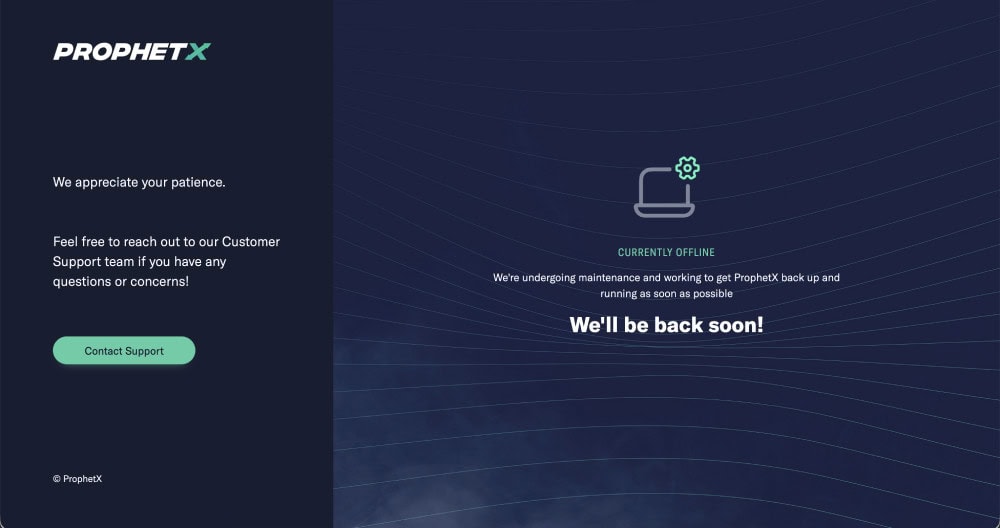
According to an email sent out to users a few days ago, ProphetX is currently offline to convert from the sweepstakes product to the new sports prediction market. In fact, the site already bears the phrase “America’s #1 Sports Prediction Market” atop its maintenance page today.
Apparently, users’ balances in their wallets will be carried over to the new version of the site, although the core product will be altered. This will probably take the brand out of the scope of the SweepsKings remit, but it highlights an interesting trend, with ProphetX seemingly riding various gray markets to keep itself relevant as the US alternative gaming sphere continues to develop in the 2020s.
A Shift Into a Contentious Gray Zone
ProphetX is clearly moving from a sweepstakes-based sports exchange into a federally-regulated prediction market operator at the same time as states, regulators, and courts are still trying to decide where sports contracts actually sit in the wider gambling framework.
It seems that another sweepstakes sportsbook – Novig – is also looking to make the same move, having submitted its application to the CFTC in January.
For these two brands, there’s also the risk of attacking a market with established, massive players like Kalshi and Polymarket, plus major adjacent brands like DraftKings and FanDuel experimenting with the concept too.
With state bans, federal frameworks, and court challenges all pulling in different directions, nothing here is really settled yet. It’s part of a live reshaping of the US betting landscape rather than a finished market, so this whole story is one to keep an eye on as it develops.

Author: Joseph Allen
Updated: