Even though the MD bills haven’t made much progress so far by March, the Mayor and City Council of Baltimore sued sweepstakes operators in the same fashion the LA City Attorney did in California last year.
This week, Maryland became the latest state to introduce an anti-sweepstakes casino proposal. In fact, two identical bills were filed in MD: HB 295 and SB 112.
This means Maryland now joins five other states with new sweeps-banning bills in 2026 – that’s a group made up of Florida, Maine, Indiana, Mississippi, and Virginia.
By the way, the filing of the same bills in both chambers of the legislature is a commonly-used tactic to ensure the fastest possible progress along both routes.
HB 295 and SB 112 Explained
The five pages of the new Maryland bills make for interesting reading; the contents buck the trend somewhat when it comes to this kind of legislation.
To start with, the definition used to target the virtual tokens of sweeps casinos here is a little more broad than usual. Whereas we often see mentions of ‘dual currency systems’, the Maryland bills opt for games that “utilize multiple currency systems”.
Next, HB 295 and SB 112 require licensed Maryland gaming operators to report annually whether they have business relationships with entities that support illegal gaming in the state. This includes relationships with financial institutions, payment processors, geolocation providers, platform providers, and media affiliates who are not operating legally.
When we say licensed operators, we mean land-based casinos, online sports betting operators, sports betting suppliers, etc. Maryland does not currently offer iGaming, so the state regulator does not license online gambling brands at this time.
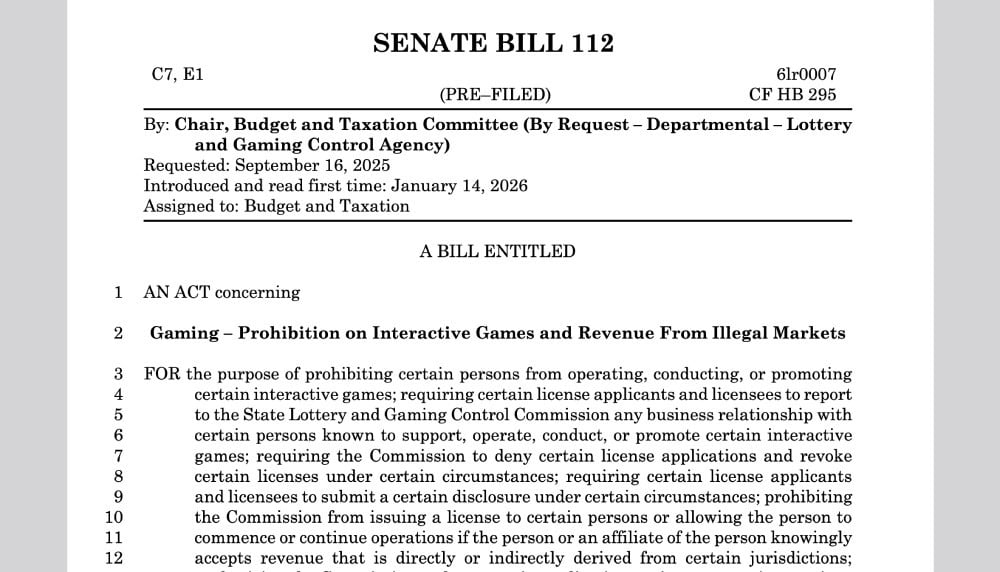
Thirdly, the Maryland bills look to examine any ties licensed operators may have to illegal gaming in other states.
For example, Section 9‑1A‑07(G)(2) states that licensees must not have “accepted revenue from the conduct of an interactive game in an illegal interactive gaming market”. Further on, there’s even a mention that licensees must not have accepted revenue derived from “a jurisdiction designated as a state sponsor of terrorism by the United States”.
Another point of difference is that most anti-sweepstakes bills we’ve seen elsewhere are sponsored by one or two named legislators. The Maryland bills, by contrast, are committee-sponsored, specifically by the House Ways and Means Committee and Senate Budget and Taxation Committee respectively.
On the other hand, the penalties – a misdemeanor judgement, up to 3 years in prison, and fines up to $100,000 – aren’t out of the ordinary. That being said, the fact that these penalties could technically apply to licensed operators who don’t report correctly, isn’t standard.
All things considered, the Maryland bills are quite detailed and far-reaching compared with other recent anti-sweepstakes proposals, creating strict compliance requirements that would significantly affect both licensed and unlicensed operators.
Maryland’s Anti-Sweepstakes Efforts from Last Year
It’s interesting to compare these two new proposals to the ones Maryland lawmakers tried to pass last year, namely SB 860 and HB 1140. They were similar in intent, but the 2026 bills add detail relating to the above-mentioned points. This is probably a smart move, as SB 860 and HB 1140 did eventually fizzle out.
For now, both new bills sit at the start of the legislative process. HB 295 is assigned to the House Ways and Means Committee, while SB 112 sits with the Senate Budget and Taxation Committee. Each bill received its first reading on January 14 with more readings to come.
We should also note that the Maryland Lottery and Gaming Control Agency (MLGCA) did issue cease-and-desist letters to some sweepstakes brands operating in the state last year, including VGW, McLuck, and Stake.us.
Some of those sweeps operators chose to withdraw, while others chose to remain. Currently, we estimate that around two thirds of all sweepstakes and social casinos are still operational in Maryland.
SweepsKings will be tracking developments in Maryland, alongside the parallel efforts in Florida, Maine, Indiana, Mississippi, and Virginia. As more states weigh enforcement, regulation, or outright bans, the future of sweepstakes casinos in the US remains hotly contested.

Author: Bogdan Lunkan
Updated: